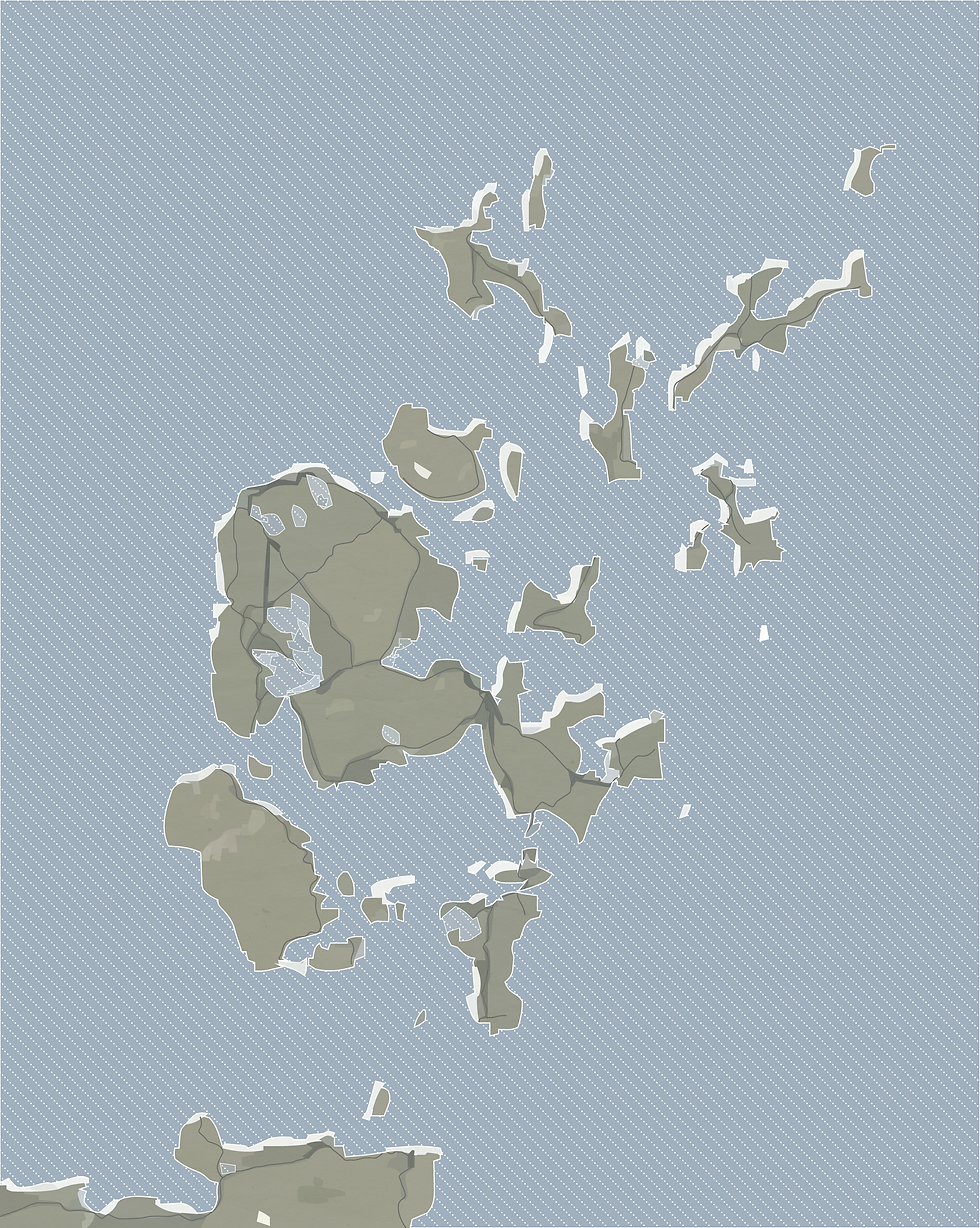
Fig. MI.S.OK.01; Orkney Map
ORKNEY
Rural Healthcare - Tom Robertson
59°00′N 3°00′W / 59.000°N 3.000°W / 59.000
SIZE: 990 km²
POPULATION: 22,020
POP. DENSITY: 22.3 people/km²
URBAN CLASSIFICATION (people/km²)
HYPER URBAN AREA (≥15,000)
DENSE URBAN AREA (1,500-14,999)
URBAN CLUSTER (300-1,499)
RURAL SETTLEMENT (50-299)
SPARSE RURAL (10-49)
REMOTE (1-9)
WILDERNESS (<1)
*BASED ON DEGURBA (EU Degree of Urbanisation) DATA
KEY ISSUES
Lacking provisions of specialist healthcare
Social isolation for vulnerable demographics
Strong potential for the development of new technologies
Demographic trends point towards further stress on healthcare.
Situated 15km north of the Scottish mainland, Orkney is a cluster of islands, 70 in total with 20 of those populated, each varying in greatly size, density and geography. The largest of these islands, known as ‘Mainland Orkney’, is significantly larger than the others, occupying around 59% of the combined land area of the entire archipelago. The islands provide a home for around 22,000 people, with the vast majority (around 19,000) residing on the mainland, while the rest are scattered across the 19 other populated islands. Most areas of the islands would be regarded as either wilderness or sparse rural spaces (farmland and such), however there are some significant urban settlements, such as Kirkwall, the principal town of Orkney.

Fig. MI.S.OK.02; Scotland Map

Fig. MI.S.OK.03; Orkney Ferry Services
One of the biggest challenges that Orkney faces is due to its location. While the islands are connected by both several minor airports and a fairly sophisticated ferry service network, travelling between islands and to the Scottish mainland is by no means easy. Cancellations are a frequent occurrence, particularly in the winter months when the storms are much more common. This is particularly challenging for vulnerable people with any kind of impairment, be that physical or mental. Likewise, it is often these people who have to travel the most, as there are less provisions on the islands for specialist healthcare, requiring patients to either seek online consultations or make the long journey to the Scottish mainland and beyond.
The Orkney isles have become a hotspot for Multiple Sclerosis. Diagnosis’ here are more frequent than anywhere else in the world. Despite this the only specialised healthcare provisions come from the Orkney MS Society, a charity providing essential support but lacking the infrastructure to make a more significant impact to the lives of patients. As the disease develops, making the journey to reach treatment becomes significantly more difficult, as mobility capabilities regress and the necessary frequency of such trips increases. Living on the remote islands becomes an ever-increasing challenge.
Within the isles, the vast majority of islanders regard themselves as belonging within their neighbourhood and feel a strong sense of community. The more remote islands of the archipelago in particular rank higher than the mainland and connected isles (consistently 10% higher). However, long-term health diagnosis’ like MS can often lead the afflicted patients to, over time, slowly peeling themselves away from social spaces.
The most common symptoms of MS include ataxia, loss of balance, severe fatigue and other similar impairments. Together, these symptoms make every action incredibly difficult for the afflicted and isolation can become a severe risk, especially in particularly remote areas.

The Orkney MS Therapy Centre at current time - a shared space with the Orkney Scout Troop
Fig. MI.S.OK.04; Orkney MS Therapy Cantre

The EMEC testing a marine renewable energy device (European Marine Energy Centre, Orkney.com, 2025).
Fig. MI.S.OK.05; Orkney Renewables
Orkney holds a defining position regarding its contributions to technological research and development, producing significant results across multiple fields. Historically, Orkney has always been a pioneer for new technologies, such as in the 1950s, when Orkney tested the first ever grid connected wind turbine. In modern times, the islands have become one of the leading figures in the development of marine renewable energy, providing an ideal location for the EMEC (European Marine Energy Centre) which is responsible for testing more grid connected ocean energy devices than any other site in the world.

Kirkwall

Stromness

Outer Island - Sanday
Fig. MI.S.OK.06, 07, 08; Orkney, Google Earth