Displacement
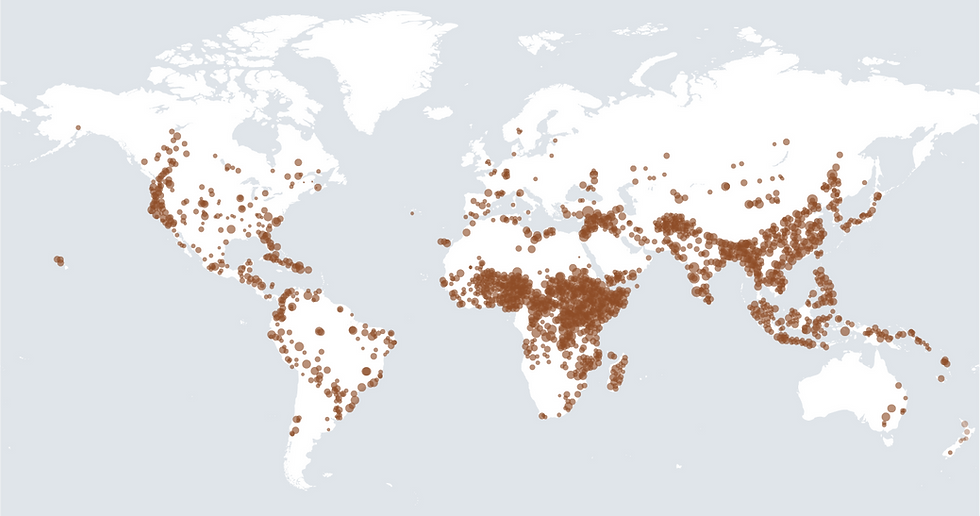
Fig. MA.D.01; Internal displacements worldwide (IOM UN Migration, Global Profiles for Internal Displacements, 2025)
RESEARCH JUSTIFICATION
As part of our investigation into a deeper understanding of displacement, we have researched current global displacement trends to understand how they are already reshaping societies globally, and their key causes. Rising conflicts and climate pressures are driving more people from their homes and widening inequalities.
Displacement of all forms can cause undue stress on existing systems, and needs to be taken into account if we are to respond effectively, and build coordinated, long-term resilience.
How is displacement impacting us now, and what are the implications for the future?
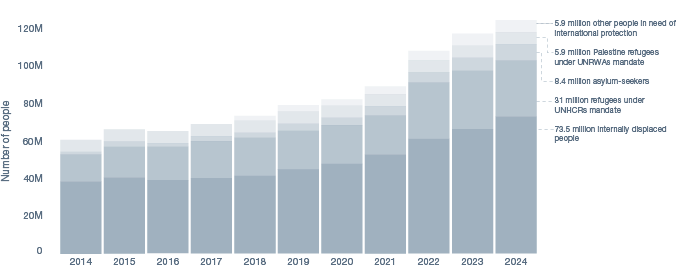
“At the end of 2024, an estimated 123.2 million people worldwide were forcibly displaced due to persecution, conflict, violence, human rights violations and even its seriously disturbing the public order.”

Forced displacement affects 1 in every 67 people globally
- UN Refugee Agency, Global Trends: Forced Displacement in 2024
Fig. MA.D.02; Displaced Peoples
Displacement Trends



Ukraine: (Reasons - conflict)
In 2024, the ongoing conflict between Ukraine and Russia caused mass displacement, with 3.7 million people displaced internally and 5.1 million fleeing abroad.
Syrian Arab Republic: (Reasons - conflict)
By the end of 2024, 6.1 million Syrians were refugees or asylum seekers, and 7.4 million were displaced internally. Despite Assad’s fall, instability persists.
Lebanon: (Reasons - conflict)
In September 2024, escalating conflict between Hezbollah and Israeli forces displaced nearly one million people.
Sudan: (Reasons - conflict)
By the end of 2024, Sudan faced the world’s largest displacement crisis, with 14.3 million people uprooted, 3.5 million more than the previous year, nearly one-third of its population.

Fig. MA.D.03; Countries with extreme displacement 2025 (UNHRC Global Trends 2024)
Democratic Republic of Congo: (Reasons - conflict)
Ongoing conflict between the Congolese army and armed groups has caused severe human rights abuses and one of the world’s largest displacement crises, uprooting 7.4 million people by end of 2024.
Myanmar: (Reasons - humanitarian)
By March 2025, Myanmar faced one of the world’s most complex and prolonged humanitarian crises, with 3.6 million displaced internally and 1.5 million forced to flee abroad.
Afghanistan: (Reasons - conflict, humanitarian disaster)
By the end of 2024, Afghan refugee numbers fell by 10% to 5.8 million. Though conflict has eased, poverty, hunger, and poor public services persist, while host nations tighten policies against undocumented Afghans.
Palestine: (Reasons - conflict, humanitarian disaster)
By the end of 2024, the genocide and humanitarian crisis in Gaza had forced mass internal displacement, with much of the population uprooted amid destruction and severe shortages of food, water, and medical aid.
*data taken from the UNHRC Global Trends 2024


Dealing with Displacement
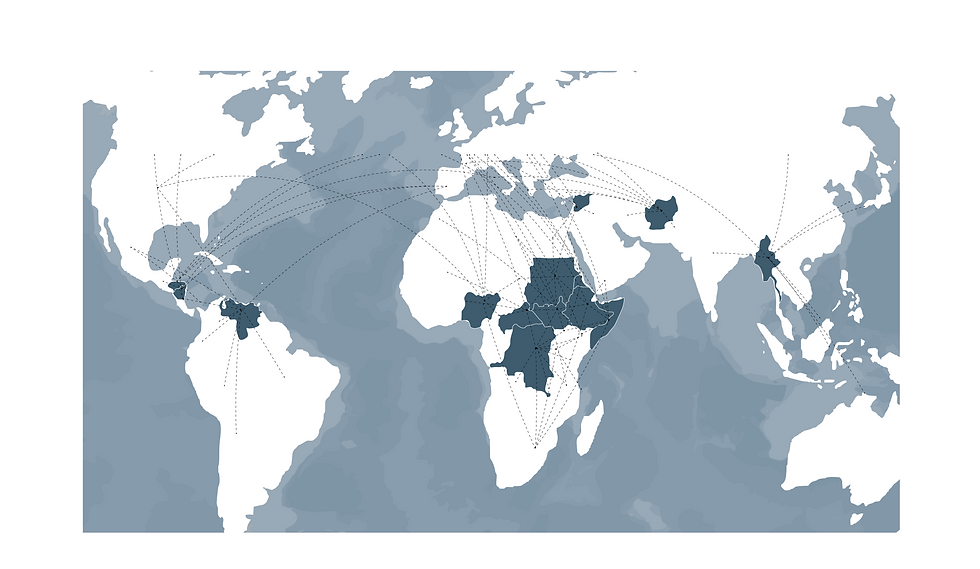
Fig. MA.D.08; 84% of refugees and asylum seekers originate from 15 highly climate-vulnerable countries
(UNHRC, Focus Area Strategic Plan for Climate Action 2024-2030, 2024)

Fig. MA.D.11; Global Displacement compared to the ND-GAIN Index
(UNHRC, Focus Area Strategic Plan for Climate Action 2024-2030, 2024)
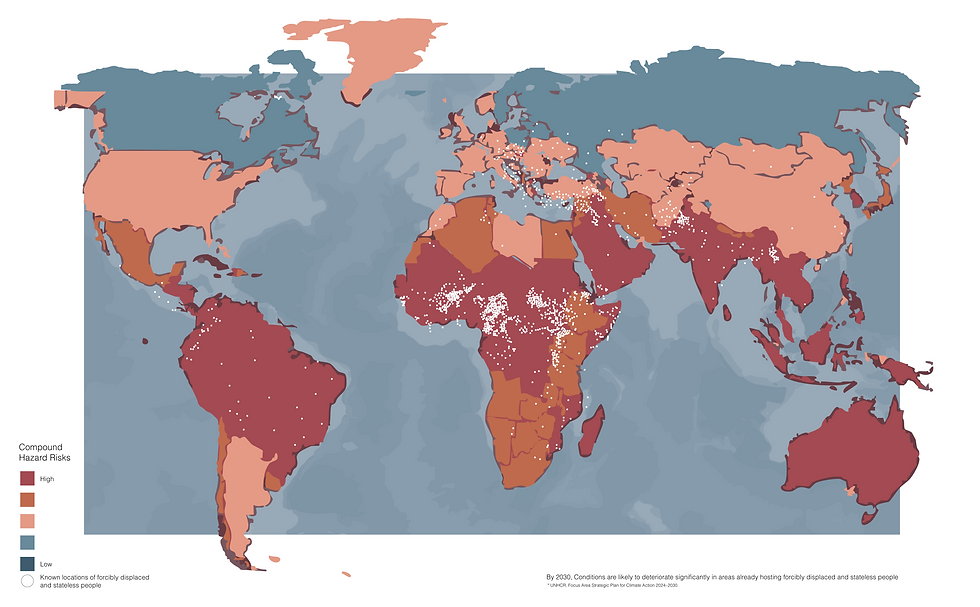
Fig. MA.D.10; Global Displacement Compared to the Current Compound Climate Hazards Risks
(UNHRC, Focus Area Strategic Plan for Climate Action 2024-2030, 2024)
Climate and Displacement
The United Nations High Commissioner for Refugees has developed guidance to mitigate future displacement due to climate related events (UNHCR, Strengthening Climate Adaption and Resilience, 2025):
-
Integrate displacement prevention into national adaptation plans, providing early warning systems, social protection, and climate-resilient infrastructure.
-
Align humanitarian, development, and climate adaptation frameworks to address displacement risk holistically rather than as emergencies.
-
Plan inclusively for managed retreat, resilient housing, and livelihood diversification to reduce forced displacement from climate impacts.
Studies have shown that climate change is linked with increases in violence and human rights violations. As global temperatures increase, this leads to other environmental impacts such as food insecurity, water scarcity, increase in infection diseases, and an increase in mental health disorders.
These increasing pressures and their associated consequences are linked with increasing conflict and collective violence (Barry S Levy, Climate Change and Collective Violence, 2018).

“Climate change is increasingly linked to conflict and human displacement. Growing numbers of people fleeing persecution, violence and human rights violations occurring in relation to the adverse effects of climate change and disasters will need international protection.”
UN (UNHRC, Focus Area Strategic Plan for Climate Action 2024-2030, 2024)
Fig. MA.D.12; 'Fleeing Destruction Sketch'

.png)
Spatial Analysis
Critical Cartography
The aim of critical cartography is to use data to garner an understanding of what happens and why (Jeremy Crampton, John Krygier, An Introduction To Critical Cartography, 2005). Through using a range of cross-disciplinary research methods, the aim is to understand patterns, relationships and trends to help enable evidence-led decisions.
In a world increasingly shaped by displacement and widening inequality, engaging with architecture and urbanism within the field of human rights is becoming an emerging area of practice. In this context, critical cartography has developed as an important tool for accountability, positioning architecture as a means of exposing structures of harm and supporting justice (Mathew Fuller, Eyal Weizman, Investigative Aesthetics, 2021).

Fig. MA.D.13; Armenian Genocide, 1915, Massacre and Deportation Routes - A visual example of critical cartography
“Maps are active; they actively construct knowledge; they exercise power and they can be a powerful means of promoting social change.”
(Jeremy Crampton, John Krygier, An Introduction To Critical Cartography, 2005)


