Healthcare

Fig.ME.P.HC.01; Authors Own, 'Healthcare Sketch'
RESEARCH JUSTIFICATION
Portugal’s healthcare system aims to provide universal access through public, occupational, and private options. Despite this, significant regional and socioeconomic inequalities persist.
Why does Portugal have one of the highest healthcare equality disparities Europe?
Healthcare System
Portugal’s healthcare system is built on three main pillars, aiming to provide access to medical care for all the population through a mix of public and private services:
1. National Health Service (The Servico Nacional de Saúde - SNS)
Established in 1979, the SNS provides universal, tax-funded healthcare under the supervision of the Ministry of Health. It offers largely free care to all residents who contribute to the social security system, covering the entire mainland, while the Azores and Madeira operate their own regional health systems.
2. Occupation-Based Health Subsystems
Social health insurance schemes are used in the public sector and in specific professions such as police, military, and banking. The largest subsystem is the ADSE (Instituto de Proteção e Assistência na Doença), which covers over 1.3 million public servants. Members of these subsystems can also access SNS hospitals and services, and many receive reimbursement for private healthcare costs.
3. Voluntary Private Health Insurance
Many people choose private health insurance to supplement public coverage and gain faster access to private healthcare facilities. The expansion of private health insurance is largely attributed to service delays and limited availability of some treatments within the public sector.
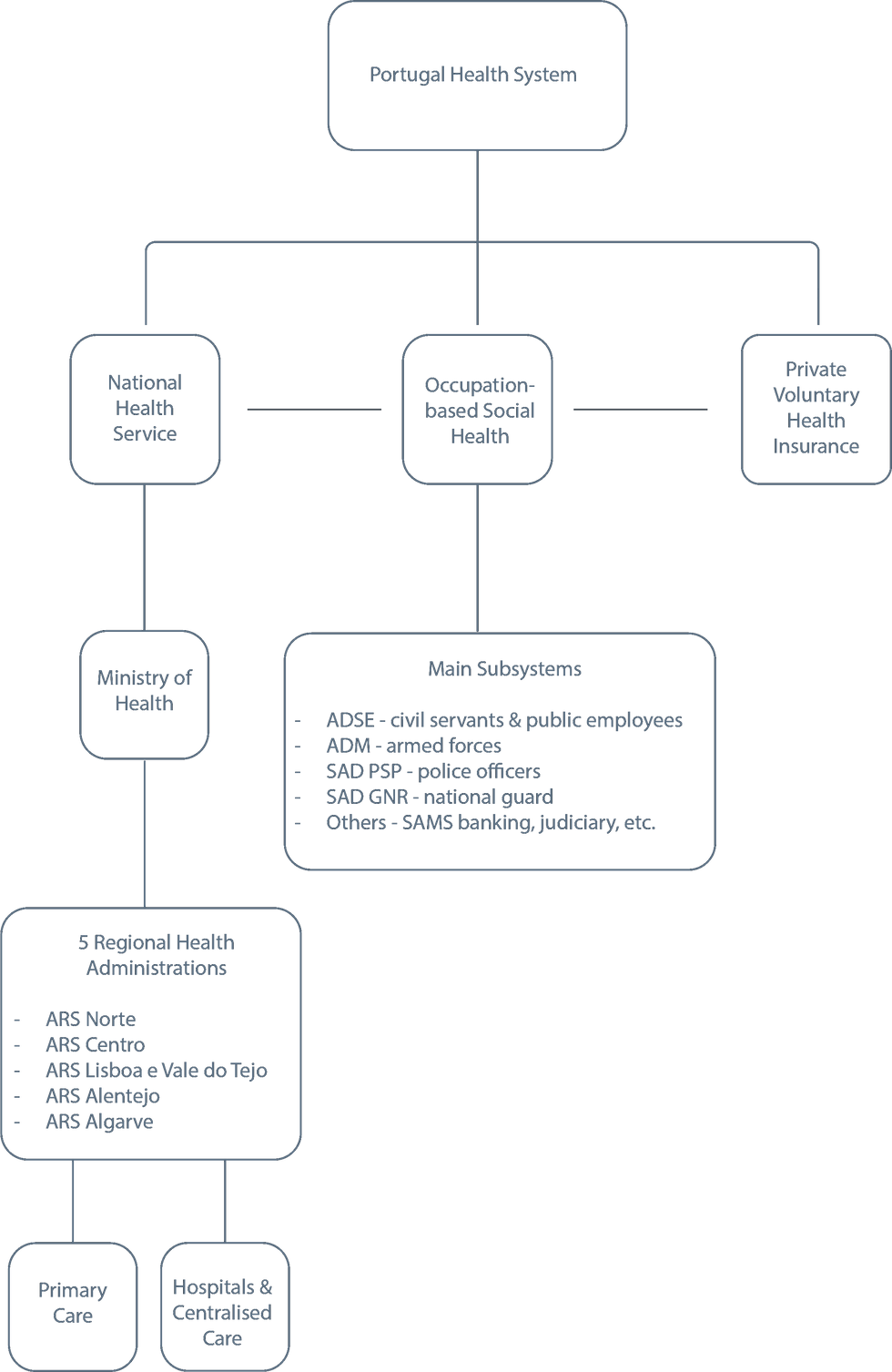
Fig.ME.P.HC.02; Authors Own, 'Portugal's centralised network for healthcare', based on, (Properstar, “Healthcare in Portugal: System, Costs, and How to Access It.” Properstar, November 23, 2018)
Approximately 25% of residents, around 3.7 million people currently hold private health insurance, a figure that has been steadily increasing.
(The Portugal News, "Portuguese above EU average for health coverage", 2025)


